

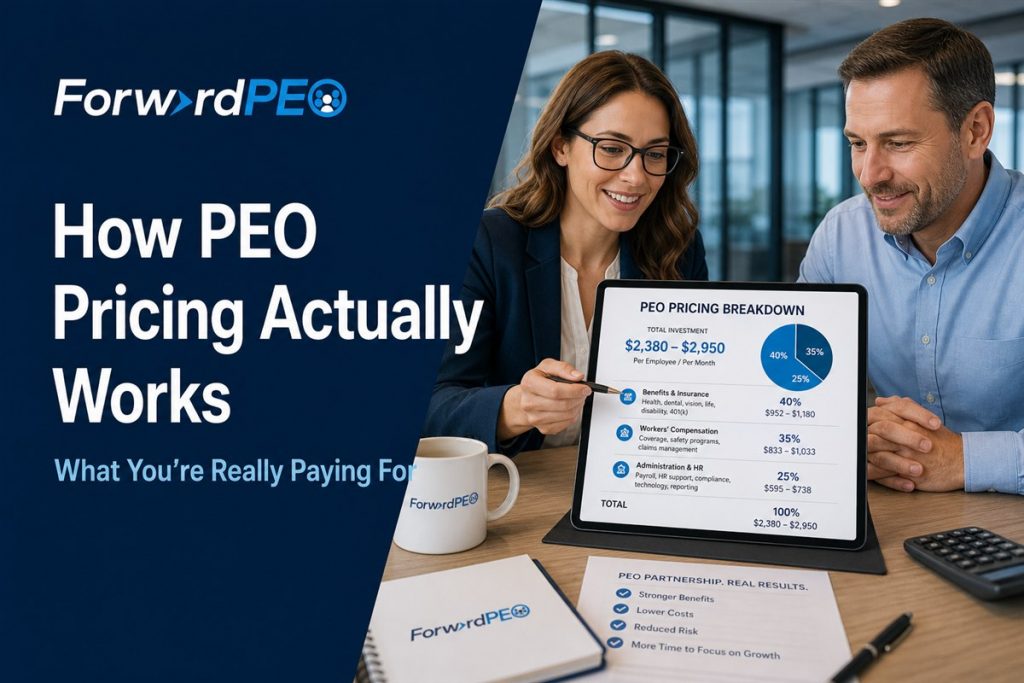
Most small business owners who reach out to me have already gotten at least one PEO quote. And most of them found it confusing. Not because the numbers were hard to understand — but because it wasn’t clear what the numbers actually meant or how they compared to anything else.
Here’s a plain-language breakdown of how PEO pricing is structured, what you’re actually paying for, and what to watch for when comparing quotes.
The Two Pricing Models You’ll See
PEOs charge using one of two structures — or sometimes a hybrid of both.
Per Employee Per Month (PEPM) is a flat fee for each employee on payroll — typically somewhere between $100 and $200 per employee per month, depending on the services included and the size of your company. The math is predictable: 20 employees at $130/month means $2,600/month in administrative fees regardless of what anyone earns.
Percentage of payroll ties the fee to total wages — commonly 2% to 6%. If your total monthly payroll is $100,000, a 4% fee adds $4,000/month. This model means your cost scales with pay increases and bonuses, which can get expensive fast for companies with highly compensated employees.
Neither model is inherently better. PEPM tends to favor companies with higher average salaries; percentage of payroll can work better for lower-wage workforces. Knowing which model you’re being quoted on is step one in comparing proposals.
What’s Bundled vs. What’s Extra
The administrative fee covers the PEO’s platform and services — payroll processing, tax filings, HR compliance support, and access to their benefits plans. But what’s included in that fee varies significantly between providers.
Some PEOs bundle everything: workers’ comp, an HRIS platform, employee handbook maintenance, state compliance updates. Others charge separately for each of those. A headline rate that looks competitive can become considerably more expensive once you add the modules you actually need.
When reviewing a proposal, ask explicitly: what is and isn’t included in the base fee? The answer will often change how the numbers stack up.
Benefits Costs Are Separate — and Often the Bigger Number
The administrative fee is only part of what you pay a PEO. The larger cost is usually the benefits themselves — health insurance premiums, dental, vision, life, and any retirement contributions.
This is also where PEOs can genuinely save you money. Because PEOs aggregate employees across hundreds of client companies, they negotiate group health rates that a 15-person or 50-person company could never get on its own. That discount — often $150 to $400 per employee per month compared to small-group market rates — can more than offset the administrative fee.
The key question isn’t just what the PEO charges. It’s what you’re currently paying for equivalent coverage vs. what you’d pay through the PEO’s plan. Those two numbers tell you whether the relationship makes financial sense.
Workers’ Comp: Often Misunderstood
Under the PEO model, workers’ comp is typically provided through the PEO’s master policy rather than your own separate policy. This can mean meaningful savings — especially for businesses in higher-risk classifications, or those that have had claims history that’s raised their rates.
Some PEOs price workers’ comp into the administrative fee. Others bill it as a separate line item based on payroll in each job classification. Make sure you know which approach you’re looking at, and compare it to what you’re currently paying.
How to Actually Compare Two Quotes
Put everything on the same basis: total annual cost per employee, all-in. Add the administrative fee, the benefits premiums your company will pay, workers’ comp, and any add-on fees. Then compare that number to what you’re spending today on the same categories.
That comparison — not the headline rate — is what tells you whether a PEO makes financial sense. I build this analysis for every client I work with, and I do it before recommending anything. If the numbers don’t work, I’ll tell you.
If you’ve got a quote in hand and want a second set of eyes on it, feel free to reach out. I’m happy to walk through it.
Let’s run the numbers together.
If you’d like an independent breakdown of what a PEO would actually cost your business — and how it compares to what you’re spending now — that’s exactly what ForwardPEO is here for. No sales pitch, just the math.
Want to understand the full cost picture before committing to a PEO?
Related: PEO Consulting Services · Hidden Fees in PEO Proposals · Book a Free Consultation