
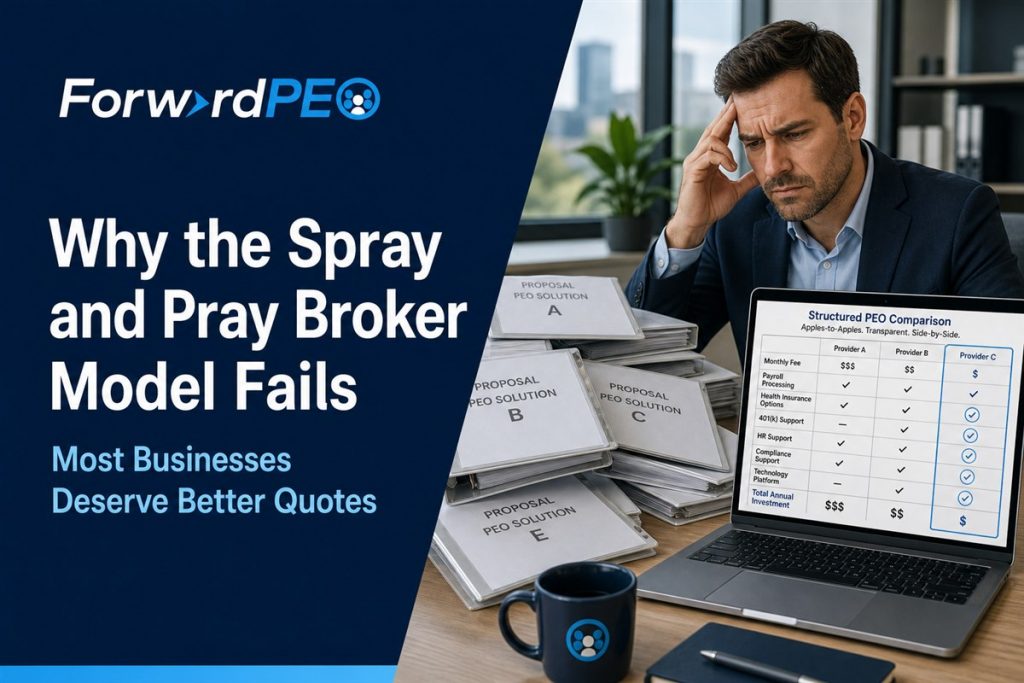
A lot of PEO Brokers / Consultants approach PEO quotes the same way they’d approach any competitive purchase: get as many quotes as possible, compare the numbers, and pick the best one. It’s a reasonable instinct. And most brokers are happy to run that process — gather your census data, submit it to eight or ten providers, and come back with a stack of proposals.
The problem isn’t the intent. It’s that PEO pricing doesn’t work like most competitive markets, and a high-volume PEO quotes process can actually produce worse outcomes than a targeted one — even when everything looks thorough on paper.
Here’s what’s worth understanding before you go through that process.
Why More PEO Quotes Doesn’t Always Mean More Leverage
In most markets, spreading your business across many vendors creates competition that works in your favor. PEOs are different, and it comes down to how they underwrite.
When a PEO underwriter receives your census as part of a wide broker submission — meaning they can see or reasonably assume they’re one of many providers being shopped simultaneously — their incentive to put forward their sharpest pricing shifts. They’re pricing defensively rather than competitively. They don’t know if they’re truly in the running or just filling out a comparison spreadsheet.
Contrast that with a targeted approach where your business has been pre-qualified, your risk profile has been clearly framed, and only two or three genuinely well-matched providers are approached. Those PEOs know they’re in a real conversation. The quality of their engagement — and often their pricing — reflects that. I’ve seen the same client profile produce materially better terms through a targeted process simply because the dynamic was different.
The Comparison Problem Nobody Warns You About
Even when a wide PEO quotes process generates solid proposals, comparing them accurately requires knowing where the structural differences are buried — and PEOs don’t make that easy. One provider quotes fees on gross payroll. Another quotes on taxable wages. That difference alone can shift the effective rate by a meaningful margin without either number being wrong.
When eight proposals land at once with eight different structures, the natural approach is to build a spreadsheet and compare line items. But the biggest blind spot most business owners have when comparing PEO quotes is not knowing their own risk profile well enough — their claims history, their experience modification rate, their benefits utilization, and where you’re headed in the next two to three years — to know which differences actually matter for their situation.
What Getting Pre-Qualified Actually Changes
The most important work in a PEO search happens before any provider sees your census: understanding your own risk profile well enough to know which two or three PEOs are actually a fit, instead of sending the same submission to ten and hoping one comes back competitive.
A PEO that specializes in construction with deep carrier relationships in your state is a fundamentally different partner than a large national provider that treats your account like one of ten thousand. A company with a clean claims history and a strong experience modification rate — which you can benchmark against NCCI’s classification data — should be negotiating from a position of strength, but only if the right providers know that going in. A business with employees in five states needs a PEO that’s actually operationally equipped for that, not one that says yes on the call and figures it out later.
Doing that diagnostic work upfront means you’re approaching two or three highly relevant PEOs with a clear picture of who you are — rather than letting ten providers build their own assumptions from a cold census submission. The proposals come back more accurate. The comparison is cleaner. And the negotiating conversation is grounded in your actual situation, not a generic version of it.
What to Ask If You’re Already Collecting PEO Quotes
If you’re already working with a broker and have PEO quotes in hand, the most useful questions to ask are: Are all of these quoted on the same payroll basis? What’s included in each quote — and what’s not? Which of these providers has meaningful experience with businesses in my industry and my size range? And what does the total cost look like in year two, not just year one?
Those questions will tell you quickly whether the process you’ve been through has the depth to support a confident decision — or whether it’s worth slowing down before you sign.
If you want a second set of eyes on the PEO quotes you’ve received, or you’re starting the process and want to make sure it’s structured to get you the right outcome, I’m happy to help. I work exclusively for business owners — no PEO commissions, no preferred providers, just an honest look at your options.
Related: How to Compare PEO Proposals · What a PEO Broker Actually Does · Hidden Fees in PEO Proposals