PEO for Manufacturing & Logistics
I help manufacturing plants, 3PL warehouses, and distribution centers cut workers’ comp costs and stay compliant without the HR headcount. No more juggling OSHA audits, EMR ratings, or seasonal workforce chaos.
No commitment. Quoted on your file. Chosen PEO pays me.
Your file goes only to the PEOs quoting you, for underwriting. I’ll reply within 1 business day.
The Manufacturing & Logistics Reality
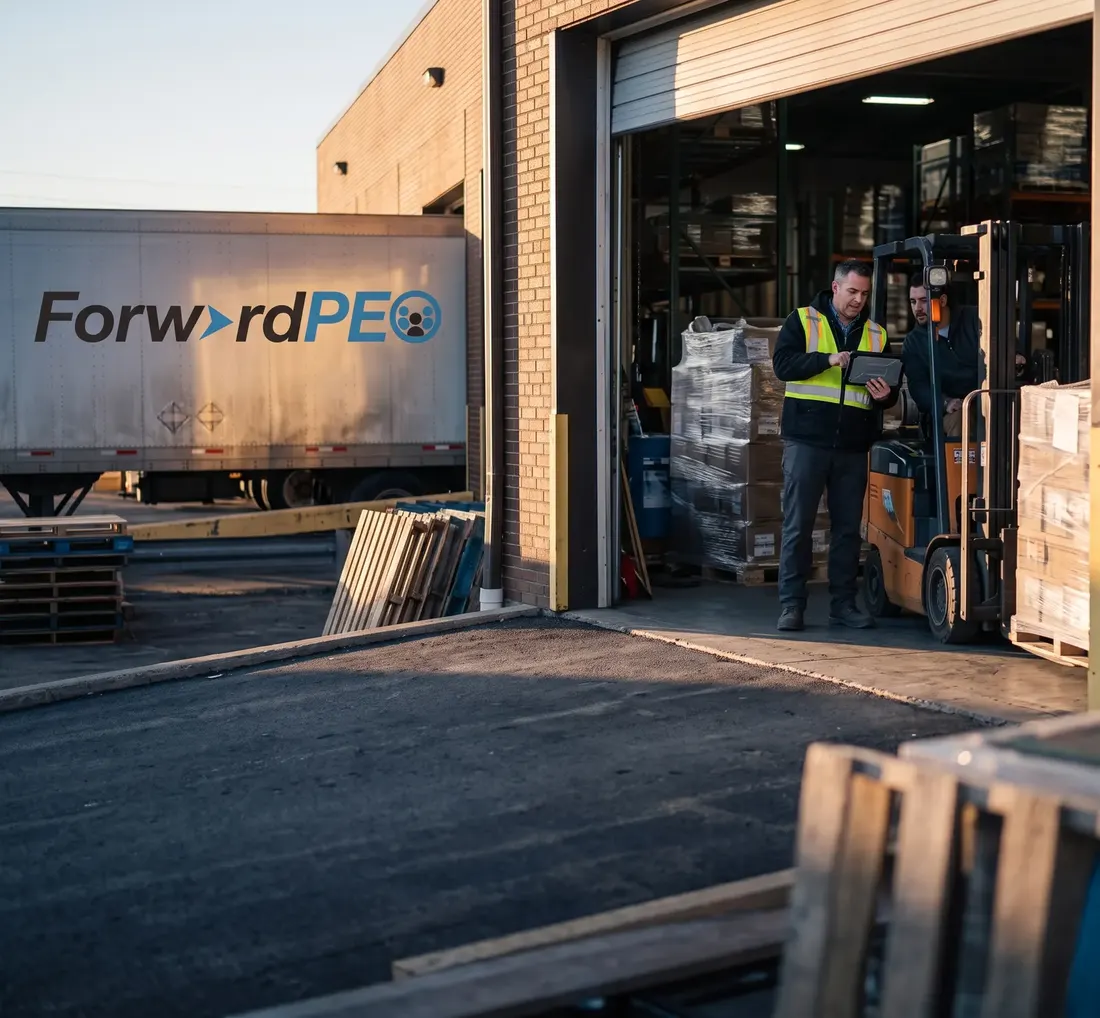
I’ve worked with enough manufacturing and logistics companies to know what keeps you up at night: workers’ comp costs that eat into your margins, OSHA compliance that requires constant attention, high turnover that makes training feel like Sisyphus pushing a boulder, and the unpredictability of seasonal demand creating payroll chaos.
Why this matters
Most manufacturing and 3PL operations are self-insured or carry individual workers’ comp policies that get worse every year. Your EMR (Experience Modification Rate) is tied to your accident history, which means one bad year on the job site can spike your rates for years. If you’re a growing operation scaling from 30 to 80 employees, you’re also dealing with the compounding administrative overhead of payroll, benefits compliance, and tax liability across multiple states.
The real cost isn’t just what you’re paying—it’s the time your operations manager spends on HR instead of optimizing your warehouse floor, or your plant manager fighting with insurance brokers instead of running production.
How a PEO Master Policy Changes the Game
When you work with me, I connect you to a PEO’s master workers’ compensation policy.
How it works
This is the key difference: instead of carrying individual policies, you’re pooled with hundreds of other manufacturers and logistics companies nationwide. Your accident history is separate from the pool’s rating. You pay based on your actual payroll and claims, but you’re not stuck with a 1.8 EMR because of one bad year.
This isn’t magic—it’s leverage. A PEO master policy is underwritten by carriers who’ve spent decades perfecting manufacturing and logistics risk assessment. They know the difference between a machine shop and a food processing plant. They understand seasonality. They’ve built their rates assuming normal industry variance.
You also get actual safety compliance support. The PEO maintains OSHA relationships, conducts safety audits, and ensures your job descriptions, hazard assessments, and incident reporting are in line with federal standards. This protects you from fines and, more importantly, keeps your people safer.
| Team | 45 employees |
|---|---|
| Comp deposits + premiums | $42,000/yr |
| Saved in year one | $11,000 |
| Saved in year two | $15,000 |
“That’s 72 hours back in their calendar every year.”
Read the full case
Case Study: Regional 3PL Warehouse
The Situation: A 3PL warehouse company with 45 employees across two locations in the Midwest. They’d been carrying individual workers’ comp policies for five years, and their EMR had climbed to 1.5 due to a few slip-and-fall incidents.
$42,000/year
That’s what they were paying in workers’ comp deposits and premiums annually.
The Move: I matched them with a PEO and moved them onto a master policy. The carrier pooled their risk with 300+ other logistics companies. Their safety record was reset in the pool’s context, and the policy was underwritten at standard manufacturing rates.
$11,000 saved
First year reduction after accounting for PEO fees. Second year, they saved $15,000 because the pool had fewer claims overall.
The Real Win: Their HR manager stopped spending 6 hours a month fighting with the insurance broker about EMR disputes and incident coding. That’s 72 hours back in their calendar every year—hours they spent training new warehouse staff and improving safety processes.
The Four Pillars of PEO Benefits for Manufacturing
PEO Master Policy Access
Get pooled with hundreds of manufacturers and logistics companies nationwide.
Why it matters
Your individual accident history doesn’t lock you into a high EMR. You pay based on payroll and actual claims in a diversified pool.

Pay-As-You-Go Workers’ Comp
No large deposits. No yearly rate adjustments that surprise you in Q4.
The details
You pay based on actual hours worked each quarter. Seasonal workforce expansion? The rate scales with you, not against you.
OSHA Compliance Support
The PEO handles OSHA recordkeeping, safety audits, hazard assessments, and training documentation.
How it works
You get compliance guardrails without hiring a dedicated safety officer.
Seasonal Workforce Flexibility
Ramping up for Q4? Scaling down in January?
What changes
The PEO payroll system handles seasonal hiring, temp worker onboarding, and tax withholding without adding permanent HR overhead.
What I Look for When Matching You to a PEO
Industry Specialization: Not all PEOs understand manufacturing and logistics.
What to look for
I work with carriers who’ve built expertise in warehouse operations, supply chain, and industrial risk. They know the difference between a light assembly operation and a heavy equipment plant.
Safety Program Depth: The best PEOs don’t just carry your insurance—they actively work to reduce claims. This means on-site safety audits, injury prevention training, and ergonomic assessments. You want a carrier that’s invested in your safety culture, not just collecting premiums.
Multi-Facility Support: If you operate warehouses, plants, or distribution centers across multiple states, you need a PEO with multi-state workers’ comp expertise. They should be able to handle varying state requirements for posting, reporting, and claims management without treating each location as a separate entity.
Payroll Integration: Your seasonal fluctuations need to translate cleanly into payroll. A good PEO has payroll software that syncs with your time tracking, manages variable hours, and calculates workers’ comp contributions on the fly—not in a quarterly audit three months later.
Industries I Specialize In
I’ve built deep relationships with PEOs and carriers that excel with:
- Manufacturing Plants: Metal fabrication, automotive parts suppliers, electronics assembly, plastic injection molding
- 3PL & Warehouse Operations: Contract logistics, fulfillment centers, distribution hubs, cross-dock facilities
- Food Processing: Meat and poultry, frozen food production, beverage bottling, bakeries
- Light Industrial: Machine shops, fabrication shops, light assembly, component testing
What You’re Not Getting Wrong
You’re not overpaying for benefits you don’t need.
How it works
Many manufacturing companies think PEO benefits packages are bloated with perks irrelevant to their workforce. That’s not how this works. I configure benefits that matter: competitive health insurance, affordable dental and vision, some retirement contribution, and disability coverage. You set the contribution levels. A warehouse worker cares about affordable health insurance and a 401(k) match—not fancy gym memberships.
You’re not trading control for convenience. You still manage day-to-day operations. The PEO handles the backend: payroll processing, tax filing, workers’ comp claims management, and compliance documentation. You control hiring, firing, schedules, and operational decisions. It’s not a staffing agency—you’re not losing control of your workforce.
You’re not getting locked into a bad deal. I review every proposed contract, every rate, every fee. If a PEO is burying costs in add-on fees or trying to charge you for basic workers’ comp services, I walk away. You’re only paying for what you use, and I negotiate to keep your costs transparent.
The Onboarding Process (It’s Fast)
Week 1: You send me your current payroll, employee roster, and workers’ comp history.
The full process
I compile this into a quote request for 5-7 PEOs that match your industry and size.
Week 2: You get proposals. You ask questions. I negotiate any terms or fees that don’t feel right. We pick a PEO and sign the agreement.
Week 3-4: The PEO’s onboarding team takes over. They set up payroll, migrate your benefits, coordinate with your current insurance broker for the transition, and create an OSHA recordkeeping setup. Your first payroll typically runs within 2-3 weeks of signing.
Ongoing: I stay involved. I review your quarterly billing, audit for hidden fees, and check that the PEO is delivering what they promised. If anything doesn’t feel right, I advocate for you.
The Questions I Get Asked Most
How much does this cost?
PEO fees are typically 3-6% of payroll, but manufacturing with better safety records often lands closer to 3-4%. If you’re paying $42K a year in workers’ comp alone, a 4% fee on a $400K payroll (~$16K) is already cheaper than what you’re paying now, plus you get benefits, payroll, compliance, and HR support bundled in.
Can I move away from a PEO if it’s not working?
Yes, but it’s usually 60-90 day notice, and you’ll need to find your own workers’ comp policy to transition to. The smart move is getting it right the first time. That’s why I’m involved—to set you up with someone who understands your business.
What happens to my workers’ comp claims history?
You keep it. Your claims are recorded, tracked, and attached to your profile in the PEO’s system. When you eventually leave the PEO, your claims history transfers with you. The benefit is that while you’re in the pool, your claims don’t spike your rate the way an individual policy would.
Do I have to offer the PEO’s benefits package?
You can customize it. If you want to offer only health insurance and no 401(k), you can do that. If you want a richer benefits menu, you can add it. The PEO will price it accordingly, but it’s your choice.
Ready to Cut Your Workers’ Comp Costs?
I’ll review your current situation, model out what you’d save with a PEO, and show you the carriers and plans that actually make sense for your operation.